
The Bull Above Kansas City: Hereford Bull in Mulkey Square Park
- AVIA AREE

- May 29
- 5 min read
Bob the Bull: Kansas City’s Strange Landmark With Serious History


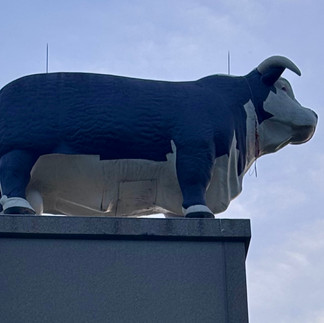


AVIA AREE — Findings of Kansas City
The first thing you notice is the height.
Not the bull.
The height.
A concrete pillar rising out of the grass near the Westside edge, traffic moving below, downtown sitting behind it, the highway cutting through the city with the usual sound of engines and exits.
Then the animal appears.
A full-bodied Hereford bull.
White face.
Heavy frame.
Still body.
Lifted above Kansas City like someone decided the city needed a witness.
You stand under it, and the whole thing feels almost impossible.
A bull in the air.
Not behind a fence.
Not on a farm.

Not inside a museum.
Above the city.
The joke lands first.
Then the history.
Kansas City once made its money in cattle, and it did not hide the evidence.It put a bull in the sky.
THE BULL WAS BUILT TO BE SEEN
The sculpture is officially called The Hereford Bull.
To people who remember its first life, it was also called Bob — short for Bull on Building.
That was not a nickname reaching for poetry.
That was the fact.
In 1954, the American Hereford Association placed the bull on a ninety-foot pylon beside its headquarters near Quality Hill, above the western edge of downtown.
Below it sat the West Bottoms.
Rail lines.
Livestock pens.
Packing houses.
Brick warehouses.
Men and machines and animals moving through the valley of the city.
This was not decoration.
It was announcement.
The bull was meant to be seen from the road, from downtown, from the approach into Kansas City.
A giant animal raised into the skyline as a symbol of the Hereford breed, the cattle business, and the old power of the West Bottoms.
Every city tells on itself eventually.
Kansas City used a bull.
BEFORE THE BULL, THERE WERE THE STOCKYARDS
It is easy now to soften the past.
To turn the West Bottoms into brick texture, weekend markets, old buildings, antique signs, and the romance of exposed beams.
But before the mood boards, there was work.
There were animals.
There was blood.
There was rail steel.
There was money.
The Kansas City Stockyards operated in the West Bottoms from 1871 until 1991.
At their height, they were among the largest in the country, second only to Chicago.
Cattle came in by rail.
Prices were set.
Livestock changed hands.
Meat moved out.
Kansas City grew around the transaction.
This city was not built only from fountains and boulevards.
It was built from yards.
Pens.
Smoke.
Labor.
Ledger books.
Hooves against wood and mud.
The Hereford Bull carries that memory in a way no plaque can.
It is too large to ignore.
Too strange to become background.
Too literal to be softened into taste.
A CHAMPION TURNED INTO A SKYLINE OBJECT
The bull was modeled after a real champion Hereford named Hillcrest Larry IV.
The sculpture itself was made from fiberglass and polyester resin over steel.
It stands nearly twelve feet tall.
It stretches almost twenty feet from nose to tail.
It weighs about 5,500 pounds.
Those numbers sound like trivia until you are beneath it.
Then the animal becomes architectural.
The body is low and heavy.
The stance is planted.
The white face catches light differently than the dark body.
The legs look fixed in a permanent kind of patience.
It is not sleek.
It is not fashionable.
It belongs to another appetite.
A champion animal became a public object.
A breed became a sign.
A business became a silhouette against the Kansas City sky.
THE CITY CHANGED UNDERNEATH IT
President Dwight D. Eisenhower came to Kansas City in 1953 for the dedication of the American Hereford Association’s new headquarters.
The bull arrived the following year.

By then, the message was clear.
Kansas City was cattle country with office buildings.
The agricultural economy had a front desk.
The stockyards had a skyline marker.
Then the city changed.
The cattle business shifted.
Meatpacking moved.
Feedlots changed the geography of beef.
Technology changed the work of breed records.
The stockyards declined and finally closed in 1991.
The old headquarters changed hands.
The bull came down.
For a time, Kansas City’s giant Hereford was no longer above Kansas City at all.
That is what happens to symbols when the economy underneath them moves on.
They become expensive.
Inconvenient.
Sentimental.
Beloved.
Embarrassing.
Necessary.
The bull did not lose its meaning.
The city had to decide whether it still wanted to look at it.
MULKEY SQUARE AND THE SECOND LIFE OF BOB
In 2002, the bull returned to public view.
It was relocated to Mulkey Square Park, near the old territory of its first life.
Now it stands in a smaller setting.
Grass below.
Traffic nearby.
The Westside close.
The West Bottoms down the slope.
Downtown still in view.
It no longer announces a corporate headquarters.
It no longer sells a breed.
It no longer has to prove the power of the cattle business.
That may be why it feels stronger now.
In the park, the bull becomes a remnant.
A body left behind by an economy that moved on.
A strange civic object that kept enough of its authority to survive relocation.
Kansas City has polished symbols.
This is not one of them.
This is heavier.
Odder.
Closer to the truth.
The Hereford Bull is funny at first glance.
It should be.
A bull on a pillar is funny.
A massive animal above traffic is funny.
A 5,500-pound piece of the beef industry standing over grass and sidewalks is funny.
But then you stand there a little longer.
The cars pass beneath it.
The skyline holds its place in the distance.
The West Bottoms sit down the hill, carrying what is left of the old city in brick, steel, rail lines, and weathered doors.
The joke begins to fall away.
What remains is something closer to grace.
A strange kind of grace, but grace still.
The bull stayed after the stockyards closed.
It stayed after the headquarters changed hands.
It stayed after the city learned to photograph its industrial past instead of work inside it.
And maybe that is why it matters.
Because Kansas City’s history was never clean.
It was physical.
It was loud.
It had weight, labor, animals, smoke, money, mud, and men keeping records while cattle moved below.
The West Bottoms was an engine before it became a backdrop.
And the bull, lifted above the city, still carries that truth without explaining it.
You look up at him now, and the first feeling is amusement.
Then recognition.
Then something softer.
The city has moved on.
The traffic keeps going.
The grass keeps growing around the base.
And above it all, the white-faced bull remains — strange, heavy, and almost tender — holding the old Kansas City in place for one more afternoon.


Comments