What Remains of the Kansas City Stockyards
- AVIA AREE

- Apr 19
- 3 min read
Updated: Apr 24
Where industry shaped belief, and belief shaped a city
Before Kansas City became a cultural identity, it functioned as a system of movement where value was determined by speed, scale, and perception.
The Kansas City Stockyards, established in 1871 in the West Bottoms, became one of the most powerful livestock markets in the United States, second only to Chicago. But their significance was never only industrial. It was psychological. They shaped how people understood movement, value, and certainty itself.
Because in systems like this, people don’t just trade goods. They begin to trust the system doing the trading.

What the Kansas City Stockyards were
The Kansas City Stockyards were a 200+ acre livestock and meatpacking hub located in the West Bottoms district of Kansas City, operating from 1871 to 1991.
At their peak, they:
processed millions of livestock annually
connected regional agriculture to national rail networks
employed tens of thousands of workers
helped define Kansas City as a major industrial center
But beyond logistics, they functioned as a structure of perception—where value was constantly assigned through movement.
Arrival
The Stockyards did not begin as a system. They began as accumulation.
Railroads converged on Kansas City because geography made it inevitable. Two rivers, expanding rail networks, and flat industrial land created a natural point of convergence where movement concentrated faster than identity could form.
The earliest livestock arrivals were not yet industry. They were signals—repeated patterns of movement suggesting something larger was forming.
And here is the underlying shift that defines all systems like this:
When repetition becomes predictable, people stop seeing movement—and start seeing certainty.
That is where the Stockyards begin.
The Rise
By the late 1800s, the Stockyards expanded from small livestock pens into one of the most important livestock markets in the United States.
Rail lines connected multiple states. Auctions set regional pricing standards. Meatpacking companies built permanent operations around the West Bottoms.
At its peak, Kansas City handled livestock volumes second only to Chicago.
But scale alone was not the defining feature.
Synchronization was.
Everything moved together:
arrival, valuation, processing, distribution.
A system like this doesn’t just manage commerce. It teaches people how fast reality is supposed to move.
The Peak
At full capacity, the Stockyards operated like a living system of coordinated perception.
Prices shifted in real time. Labor moved continuously. Supply dictated behavior. Demand shaped expectation.
And at this stage of any system, something subtle happens:
People begin to trust the system more than they trust their own judgment.
That is how industrial systems become invisible. Not through force—but through repetition that feels natural.
Kansas City was no longer just processing livestock.
It was processing certainty.
The People
Behind the machinery were thousands of workers—immigrant communities, Black labor groups, and rural migrants who formed the backbone of daily operations.
Work was physically demanding and economically unstable, but it created entire ecosystems of life in the West Bottoms.
Neighborhoods formed around the system. Generations grew inside its rhythm.
The city did not grow beside the Stockyards.
It grew because of them.
The Shift
By the mid-20th century, the structure that supported the Stockyards began to dissolve.
Agricultural distribution shifted toward direct shipping models. Rail dependency declined. Meatpacking decentralized.
But the real change was not logistical.
It was perceptual.
Once a system stops feeling essential, it begins collapsing faster than its infrastructure suggests.
The 1951 Flood
The Great Flood of 1951 accelerated this transition.
Water overtook the West Bottoms, damaging rail lines, buildings, and industrial infrastructure. Recovery was partial, but the system never regained its former scale.
After the flood:
companies relocated
operations reduced
labor networks dispersed
The structure continued—but its center no longer held.
The Fall
In 1991, the final cattle auction took place.
There was no dramatic collapse. No single moment of ending.
Just the final cycle of movement—and then silence.
What remained was infrastructure without function, and memory without a system to carry it forward.
What remains
The Kansas City Stockyards are often remembered as industrial history.
But systems like this do not disappear. They convert into perception.
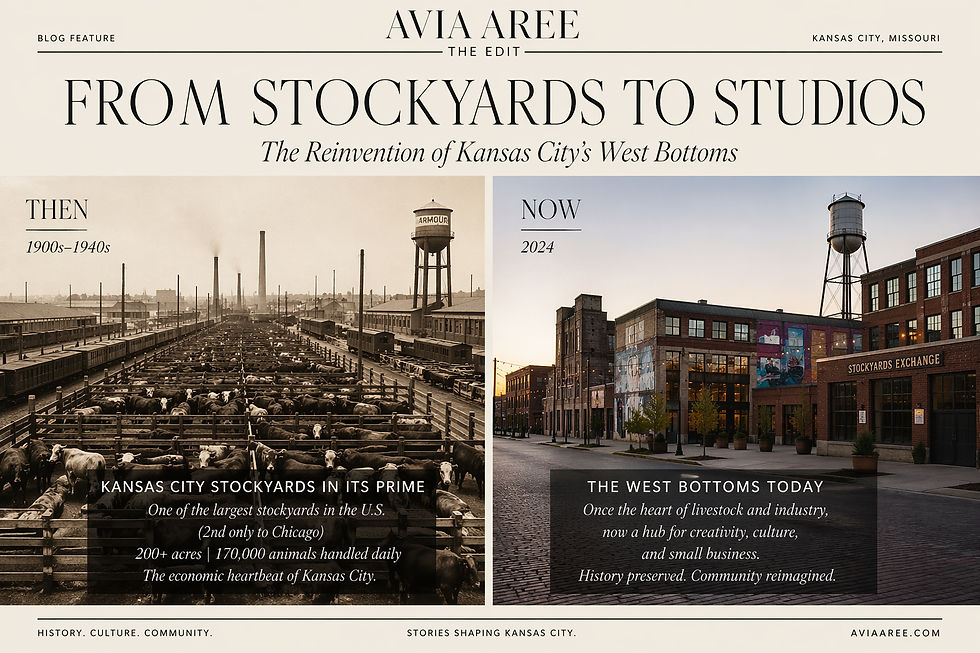
They become stories people repeat without realizing they are describing how belief once moved through physical space.
The Stockyards shaped more than an economy.
They shaped how scale is understood—how movement becomes meaning, and how repetition becomes trust.
And when the system ended, it didn’t erase itself.
It left behind something quieter:
The feeling that it was always temporary—even when it felt permanent.


Comments