FALL, MADE HERE
Wind usually tells you before the calendar does.
It comes down the block a little cooler and gets underneath the leaves. They scrape across pavement. Porch lights come on earlier. The shadows around old houses stretch farther across the yard.
There was a time when that was enough to make October feel enormous.
You could walk past a dark upstairs window and wonder—seriously—if ghosts were real. You could smell wood smoke somewhere beyond the houses and assume something was happening that you had not seen yet.
Fall had suspense.
Maybe that is the part worth getting back.
Kansas City does not need another list of pumpkin-spice drinks to prove September is over. Look closer.
Someone is stirring white miso into pumpkin. Someone else is browning butter for apples. A Swiss pastry kitchen is putting Kansas City brisket into quiche. In Parkville, a baker is working inside a house that once belonged to somebody else's daily life. On St. John Avenue, people will spend an October Saturday feeding wood into a kiln until pottery comes out glowing. Across town, a room will fill with fragrance as people decide what they want this particular fall to smell like.
These are small things. That is precisely why they matter.
This fall, Kansas City has fingerprints on it.
POSTCARDS FROM THE CITY
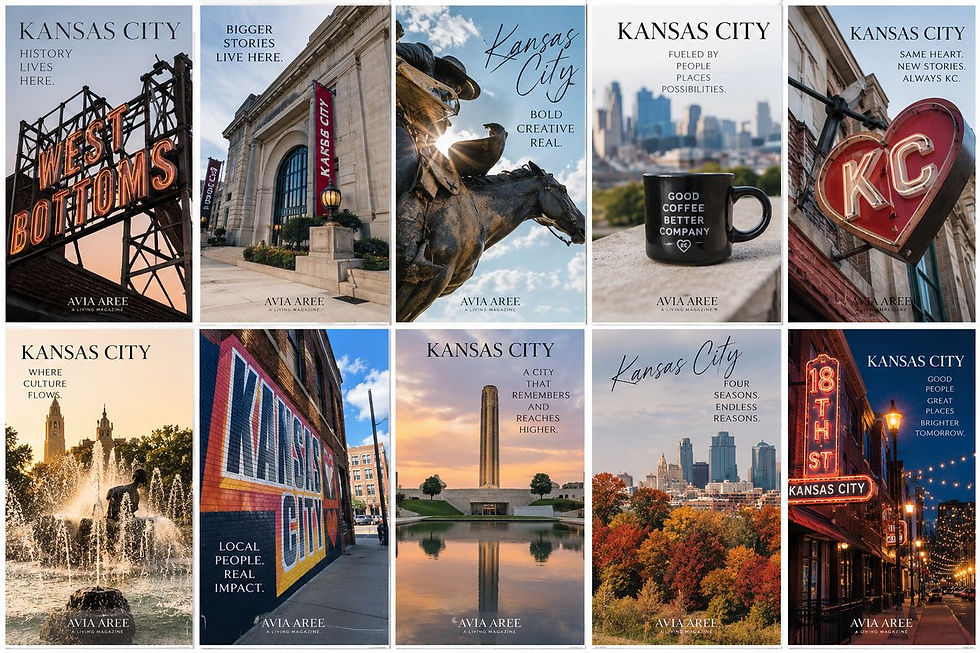
Kansas City, saved in ten small frames—brick, neon, fountains, skyline, and the trees beginning to turn.
PUMPKIN, WITHOUT THE SUGAR
Pumpkin has been assigned a very specific job in America.
Give it cinnamon. Give it sugar. Put it in coffee. Put whipped cream on top.
Mildred's has another idea.
Its seasonal menu takes pumpkin toward the savory side with miso-pumpkin soup—puréed pumpkin and white miso finished with soy-glazed, furikake-seasoned pumpkin seeds.
The miso changes the entire proposition. Pumpkin becomes earthy again. Salt and fermentation take over where brown sugar usually would. The pumpkin seeds bring it back to itself.
It is the sort of bowl that makes you want to ask who first stood in the kitchen and said: put miso in it.
There are sweeter things nearby: a sweet-potato-pie matcha made with house-made sweet potato syrup, cold foam and cinnamon, and pumpkin-cheesecake loaf.
But the soup is the one we keep thinking about.
Availability has been moving between Mildred's locations, so check the current menu before making the trip specifically for it.
ONE APPLE. TWO FALLS.
There is something almost unfair about what happens to an apple once butter gets involved.
At Seven Swans Crêperie, the fall menu lets the same fruit tell two different stories.
The Brown Butter Apple Crisp Crêpe, $16, takes the familiar route toward dessert: roasted cinnamon apples, oat crumble, sweet whipped cream, brown-butter caramel and vanilla ice cream.
Then comes the Vermonter, $18: local rosemary pork sausage, sharp white cheddar and caramelized apples.
Same fruit. Entirely different weather.
That is what makes the pairing interesting. Order one sweet and one savory and the apple becomes the thread running between them.
There is also something worth watching in a crêperie during fall. Batter hits a hot surface. Steam lifts. A thin circle is spread, filled, folded and handed across the counter.
The season becomes physical.
Seven Swans' current Kansas City hours are Wednesday through Sunday, 8 a.m.–3 p.m. Seasonal menus move, so check before going.
WHEN SWITZERLAND MEETS A KANSAS CITY BRISKET
Kansas City brisket usually arrives with certain expectations.
Smoke. Bark. Sauce. Maybe butcher paper.
At André's, beginning September 29, it goes into quiche.
The seasonal Q39 BBQ Quiche brings Q39 brisket and barbecue sauce together with Swiss Gruyère and Emmentaler, caramelized onions and Calabrian peppers. A whole quiche is listed at $42.
On paper, it sounds almost improbable. In practice, the idea works because neither side of the collaboration is being asked to disappear.
Kansas City remains Kansas City. André's remains unmistakably Swiss.
There is an entire story inside the hands making it: brisket, custard, peppers and Swiss cheese assembled into something that could not have come from either tradition alone.
The fall bakery case extends the season farther. Gingerbread leaves. Acorns. Small shapes behind glass.
The sorts of things adults buy because they are beautiful and children choose because an acorn made of gingerbread is obviously better than an ordinary cookie.
Sometimes sophistication is overrated.
THE BAKERY INSIDE THE HOUSE
Drive into Parkville in fall and the town does some of the work for you.
The hills. Older buildings. Trees close to the street.
Then there is Wild Flour Baking Co.
Megan Andersen moved her baking business out of her home and into another house—this one converted for the bakery.
That distinction matters.
A storefront gives you a counter. A house gives you rooms. Windows. A porch. The residue of another purpose.
And fall does strange things to houses.
A porch looks different under gray light. A window reflects trees instead of sky. The wind pushes leaves up against steps and suddenly a building you have driven past twenty times deserves another look.
We do not need to tell you the house is haunted. We have no evidence that it is.
It is almost better that way.
There was an age when an old house did not need a documented ghost story. A staircase, an unfamiliar room and one unexplained sound were enough.
Wild Flour gives us the grown-up version.
Go inside. Buy something from the case. Look around the rooms. Think for a second about how many completely different lives a building can hold. Then take the pastry with you.
We are still watching Wild Flour for its specific 2026 fall bake list. The house and the person behind the ovens were enough to put it here before pumpkin ever entered the conversation.
SPEND AN OCTOBER SATURDAY FEEDING A FIRE
There are easier ways to acquire pottery.
That is not the point.
At Back Door Pottery, ceramic artist Rebecca A. Koop offers a two-part wood-fired Raku experience scheduled for October 17 and October 24.
First, participants make the work. Then they return. Glaze it. Cut wood. Feed the kiln. Bring the temperature toward 2,000 degrees. And watch the pieces come out red-hot.
That last part changes the equation.
You are not simply attending a craft class and collecting the result later. You are there for the transformation.
Clay. Heat. Smoke. A finished object that did not exist before your hands got involved.
There are few fall activities better suited to the season than standing near a wood fire while the air gets colder around it.
The studio sits on St. John Avenue, away from the predictable fall circuit.
Exactly where we would rather be.
October 17 + October 24, 2026. Registration, remaining spaces, workshop time and final pricing should be confirmed directly with the studio before attending.
DECIDE WHAT OCTOBER SMELLS LIKE
Memory has peculiar storage habits.
A photograph may need context. A song needs a few notes. Smell can open the entire room at once.
That idea sits underneath Heaven Scent Collective.
On October 24, guests will use ceramic pumpkin vessels and choose among fall fragrances to create their own blend.
The workshop runs 2–4 p.m. Tickets are listed at $50, plus tax and ticket fees.
Pumpkin vessel aside, the interesting decision is not what the candle looks like.
It is what you decide your fall should smell like.
Wood? Spice? Something darker? Something sweet enough to resemble a kitchen you remember?
Fragrance is personal territory.
Two people can smell the same candle and end up in completely different years.
A CANDLE NAMED AFTER HOME
Before Harmony Lane was a candle company, it was an address.
The business began as a mother-and-daughter project. Its name came from the first home the family shared.
That gives the fall collection a different weight.
Harvest Moon. Cider Night. Sugared Pumpkin Butter.
Seasonal names, yes. But they are being poured by a Kansas City family whose business itself is named after a house they remember.
That is the story inside the story.
We talk about scent because it changes a room, but we buy candles because rooms matter to us.
The first apartment. The family kitchen. A grandmother's house. The place you lived when your children were small. The bedroom window that used to rattle when the wind picked up.
Sometimes the product is the candle. Sometimes the product is getting a room to feel like yours.
KEEP A LITTLE OF THE SUSPENSE
There will be bigger fall events.
There will be festivals with parking lots full of cars, pumpkin patches designed for photographs and enough cinnamon syrup to carry Kansas City through November.
Go to those, too.
But leave room for the smaller things.
Split the apple crêpes. Try pumpkin with miso. Bring home an acorn made of gingerbread. Walk into the bakery that still looks like a house. Stand near a kiln and watch clay turn red. Make a candle without asking anyone else what fall is supposed to smell like.
Because somewhere along the way, adulthood made the season terribly easy to explain.
The temperature drops. Leaves lose chlorophyll. Daylight gets shorter.
Perfectly reasonable.
And considerably less fun than being eight years old, hearing something move outside the window and wondering whether ghosts might actually be real.
The wind moves down the block.
Leaves chase one another along the curb.
There is smoke somewhere.
A porch light clicks on.
For half a second, you do not know what is around the corner.
Keep that part.



Comments