Something Was Still There

Commerce Trust at 10th & Walnut — Kansas City, 1934
I stopped for the stonework. There was something about the doorway I couldn’t put my finger on. I hadn’t yet heard of Webster Kemner.
EDITOR’S NOTE: Faye is fictional; her movements, clothing, meal and dialogue are reconstructed from period evidence. Named people, dates and reported events are sourced. Full methodology appears in the Research Note.
Title photograph: LaRee Durden / AVIA AREE.
Watch the complete narration · 26:40
Faye’s AI-narrated edition, with the article’s cover photograph. All six chapters play in story order.
Photography: LaRee Durden / AVIA AREE. Faye is a fictional narrator.
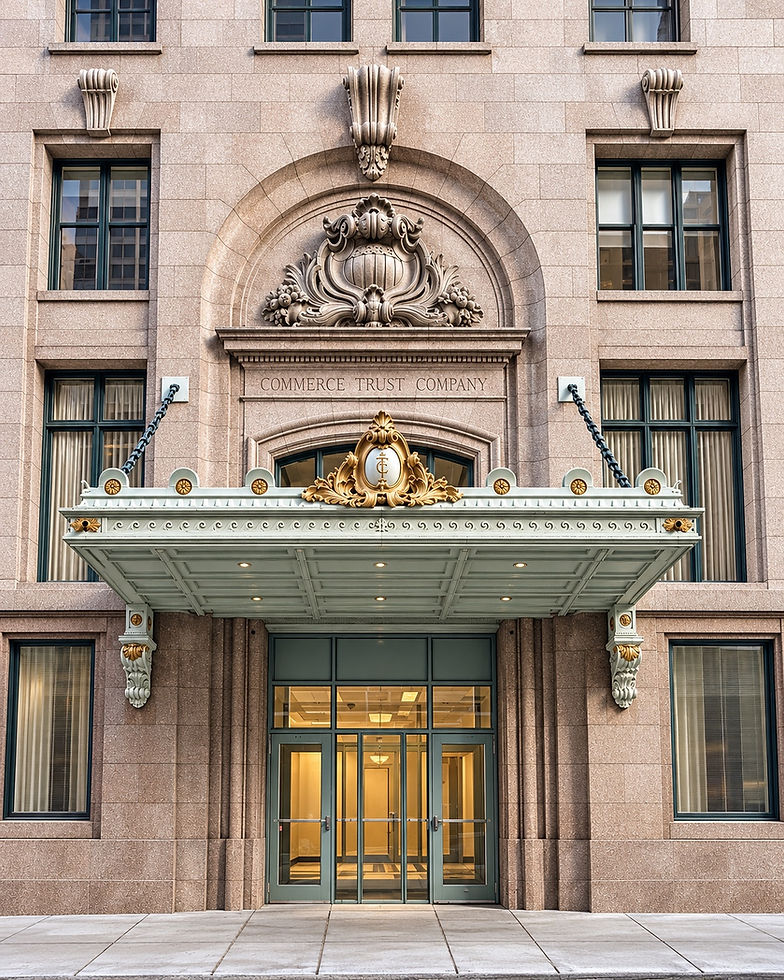
Something about the building stopped me in my tracks.
I was not out looking for a story. I was driving through downtown Kansas City when I caught the entrance out of the corner of my eye and looked twice.
Then I pulled over and took the photograph.
Red granite, weathered toward rose in the light. Dark windows. White terra-cotta ornament climbing above the entrance. Brick and mortar carrying the building upward. Heavy chains holding the canopy. A flash of gold. Above the door, a name cut deeply enough into the façade to outlive the people who put it there: COMMERCE TRUST COMPANY.
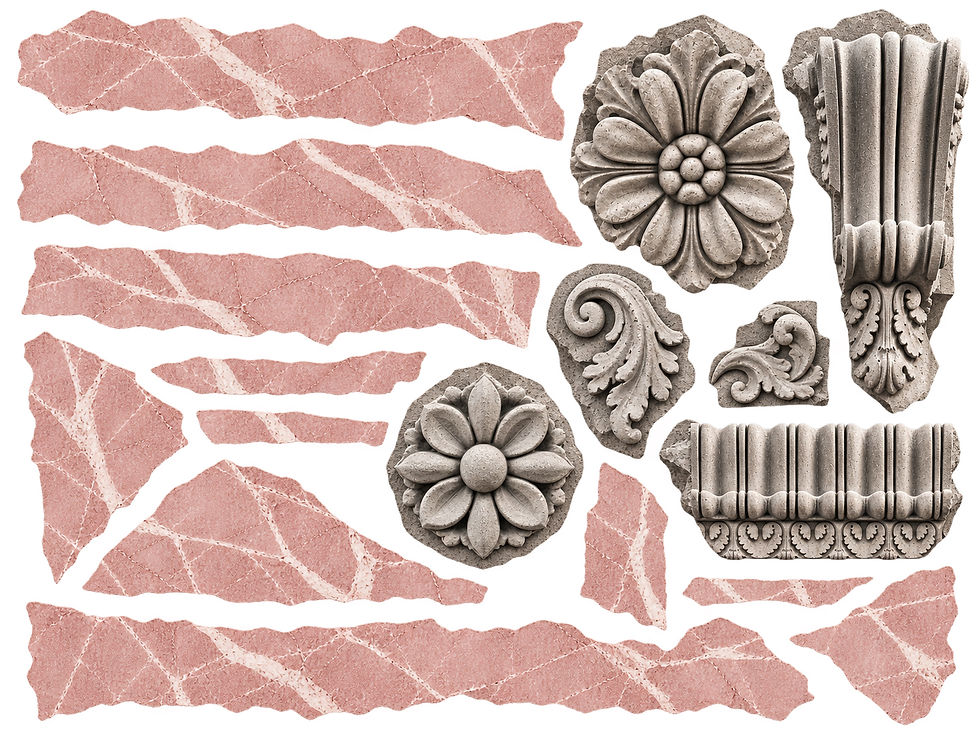
OBSERVATION — MATERIALS Up close, the building is not one surface but several: red granite at street level, Brazilian brick through the body, white terra cotta carrying the ornament, and structural steel doing the hidden work. The eye reads weight, repetition, seam, chip, mortar, curl. What looked like one façade from the car breaks into parts.
Carved stone detail. Original photograph: LaRee Durden / AVIA AREE.
I tell people back home that buildings in Kansas City look like they are holding stories.
I mean that almost literally.
Some places hit me before I know anything about them. I can feel the history before I have the names. I can almost taste old conversations in the air — cigarette smoke that is no longer there, wet wool coats, polished floors, gasoline, somebody hurrying because the streetcar is coming.
It is not exactly a ghost feeling.
It is closer to recognition.
OBSERVATION Sometimes Kansas City gives me the strange sense that I have been here before, though I know I have not. Maybe it is nostalgia. Maybe imagination. Maybe some ancestral subconscious noticing proportion, stone, iron, old doors — the physical residue of other people’s lives.
Whatever it is, this building was screaming at me without making a sound.
So I went home and looked it up.
That is when the doorway changed.
It stopped being an impressive old bank entrance and became a place where people had worked, waited, carried money, made decisions, survived financial panic, stood in payroll lines and, one February afternoon, watched a man die on Walnut Street.
The deeper I went, the less I wanted to write a history lesson.
I wanted to stand on the block long enough to understand what an ordinary day might have felt like before it stopped being ordinary.
Faye is fictional. Pencil-style illustration created for AVIA AREE.
So I imagined Faye.
Not as a ghost. Not as a historical person I am pretending existed.
As a way into the room.
FAYE’S NOTEBOOK Before the gunshot, it was still only Tuesday.
Faye had chili at Wolferman’s.
I put her downstairs in the Grillette at 1108 Walnut, her coat folded across her knees. I gave her a modest felt Stetson cloche and plain dark Fownes kid-leather gloves, tucked into the crown. A spoon rested against the bowl. She broke a cracker with one hand and kept the other around her coffee cup.
Wardrobe reference: Stetson · Fownes / Centric Brands
The pie I give her is lemon meringue. Yellow filling beneath a cap browned at the tips. Her fork pressed through the soft white top, then caught on the pastry. A little lemon remained on the tines.
It was Tuesday, February 27, 1934.
Kansas City had fallen to 13 degrees below zero that morning — the lowest temperature recorded in the city that year. Upstairs, beyond the restaurant’s warmth, people were crossing Walnut with their chins buried in their collars.
Faye was twenty-eight in our telling, a stenographer in an office in the Commerce Trust Building. Letters waited on her desk. Carbon paper. A shorthand pad. An employer who could dictate a page without remembering that anyone had to type it.
Under her dark wool coat she wore Nelly Don: an ink-blue jersey dress, fitted through the waist, with a twisted belt and small buttons near the throat. The skirt skimmed her hips and fell to mid-calf, its pleats opening when she walked. Long sleeves narrowed toward her wrists. She kept the cuffs clear of the typewriter ribbon.
Nelly Don meant Nell Donnelly, whose dressmaking business operated farther south on this same street, in the Corrigan Building at 1828 Walnut.
And Nell Donnelly meant something else to the women at the counter.
“Mrs. Reed now,” one said.
“She’ll still be Nelly Don to me.”
Nell had married former Senator James A. Reed in December. The wedding was scarcely two and a half months old. The kidnapping came into their conversation too: December 1931, Nell and her chauffeur held for ransom, Reed helping organize the search.
Faye looked down at the belt across her own waist while they talked.
Farther along the counter, two men had reached Johnny Lazia. His February 14 tax conviction was still fresh; his lawyer, Jerome Walsh, was asking for a new trial. One man lowered his newspaper. The other left his coffee untouched while he answered.
Faye had to get back.
She paid, fitted the gloves over her fingers and stepped onto Walnut. The cold caught inside her nose. A streetcar bell cut through the traffic.
At Eleventh, Emery, Bird, Thayer occupied the block stretching east toward Grand. West along Eleventh lay Main Street and Harzfeld’s, where Faye had paused before lunch to look at a coat she had no intention of asking anyone to take out of the window.
Now she turned north toward Tenth, one hand keeping her felt hat in place. Her skirt brushed her stockings beneath the heavier swing of her coat.
FAYE NOTICES At street level the granite reads almost brown in the February cold. Higher up, the pale terra-cotta curls and floral details catch what little light there is. Brick settles into shadow between the windows. She does not stop to study any of it. She only looks up long enough to know she is back.
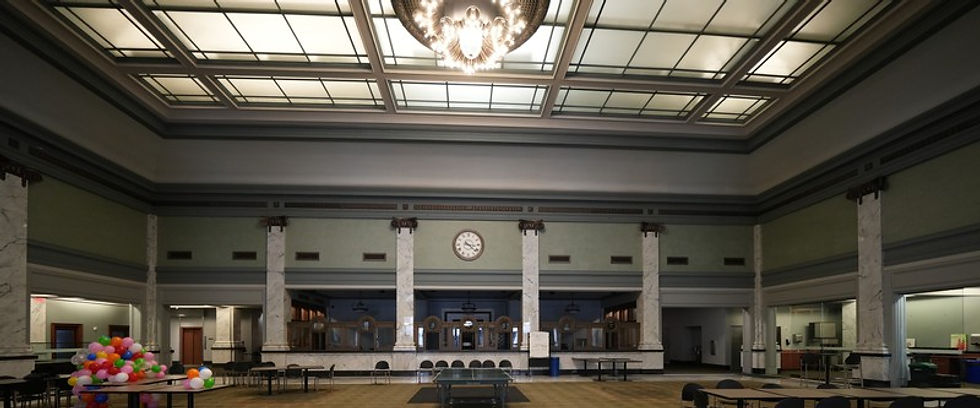
Inside Commerce Trust, the streetcar bell dropped away. Shoes sounded against the marble. Paper slid across a counter. Behind the teller windows, hands sorted slips and counted money.
Faye opened her purse for the deposit slip she had filled out that morning.
The woman ahead of her had unbuttoned a black wool coat with a thick fur collar. Beneath it, a fitted jacket drew in at the waist above a straight skirt. A small felt hat tilted over one eyebrow. A pearl sat at each ear. Her stockings ran without a wrinkle into polished black pumps.
She removed one kid glove by easing each finger loose, then laid it beside her handbag. A diamond caught the light as she pushed a check toward the teller.
Harzfeld’s, Faye decided.
She could not see the label. She could see the hem: level, finely finished, exactly where it ought to be. Nothing pulled across the woman’s shoulders when she reached.
Faye smoothed her own skirt.
Above them, the ceiling held the light; below, the polished floor returned fragments of shoes, coats and moving legs. The woman took her receipt, drew on her glove and pressed the clasp of her handbag shut.
Faye stepped forward.
Then it was back upstairs. She set her handbag beside the desk and pulled a fresh sheet into the typewriter.
THE BLOCK
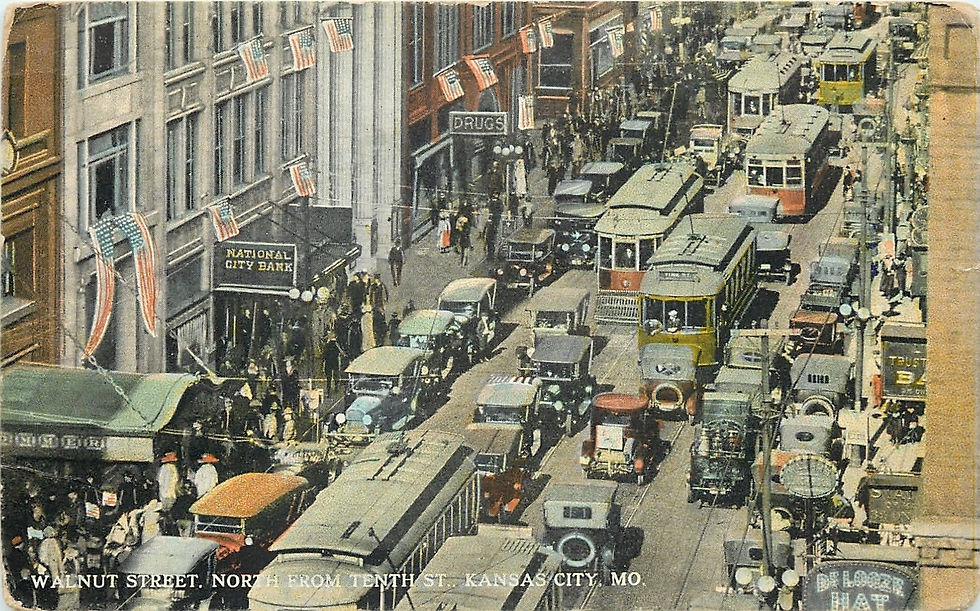
Walnut Street looking north from 10th Street, circa 1918. Colorized postcard published by Hall Bros. Public domain; source: Wikimedia Commons. It predates the 1934 robbery and shows the banking corridor, streetcars and density of the block.
THE BLOCK 10th & Walnut. National Bank of Commerce / Commerce Trust. Jarvis Hunt, architect. Building completed in 1908. One block north: 9th & Walnut and the Fidelity tower. February 27, 1934: Webster Kemner would be killed between them.
This part of Kansas City was built around money.
Banks and trust companies crowded Walnut. Streetcars cut through the grid. Office workers crossed the same intersections as messengers carrying checks, bonds, cash and paperwork between institutions.
Men moved along the sidewalks in suits and heavy overcoats, felt hats pulled down against the cold. Women crossed between offices and stores in wool coats, dresses, hats and gloves.
The cars still showed their machinery openly — upright bodies, separate rounded fenders, running boards, narrow tires.
The streets were modern enough for motor traffic and old enough that nearly every automobile still looked assembled from visible parts.
At Ninth and Walnut stood the recently completed Fidelity National Bank and Trust tower, an Art Deco skyscraper finished in 1931.
Its bank failed in 1933.
Architecture could project permanence even after the institution behind it had collapsed.
One block south stood Commerce Trust.
Granite at the base. Brick and terra cotta above it. Steel underneath.
Chicago architect Jarvis Hunt designed the building. The George A. Fuller Company completed it in 1908. Hunt would later design Kansas City Union Station.
The bank building was made to do what large financial institutions often asked architecture to do in that period: look permanent enough to calm anyone walking through the doors with money.
It had two faces.
The National Bank of Commerce operated from the Walnut Street side. Commerce Trust used the Tenth Street entrance.
That second doorway still carries its name in stone.
OBSERVATION — THE ORNAMENT The floral rosettes, scrolls, fluting and repeating edges stop reading as background once you stand beneath them. They pull the eye away from the whole building and into its smallest carved decisions.
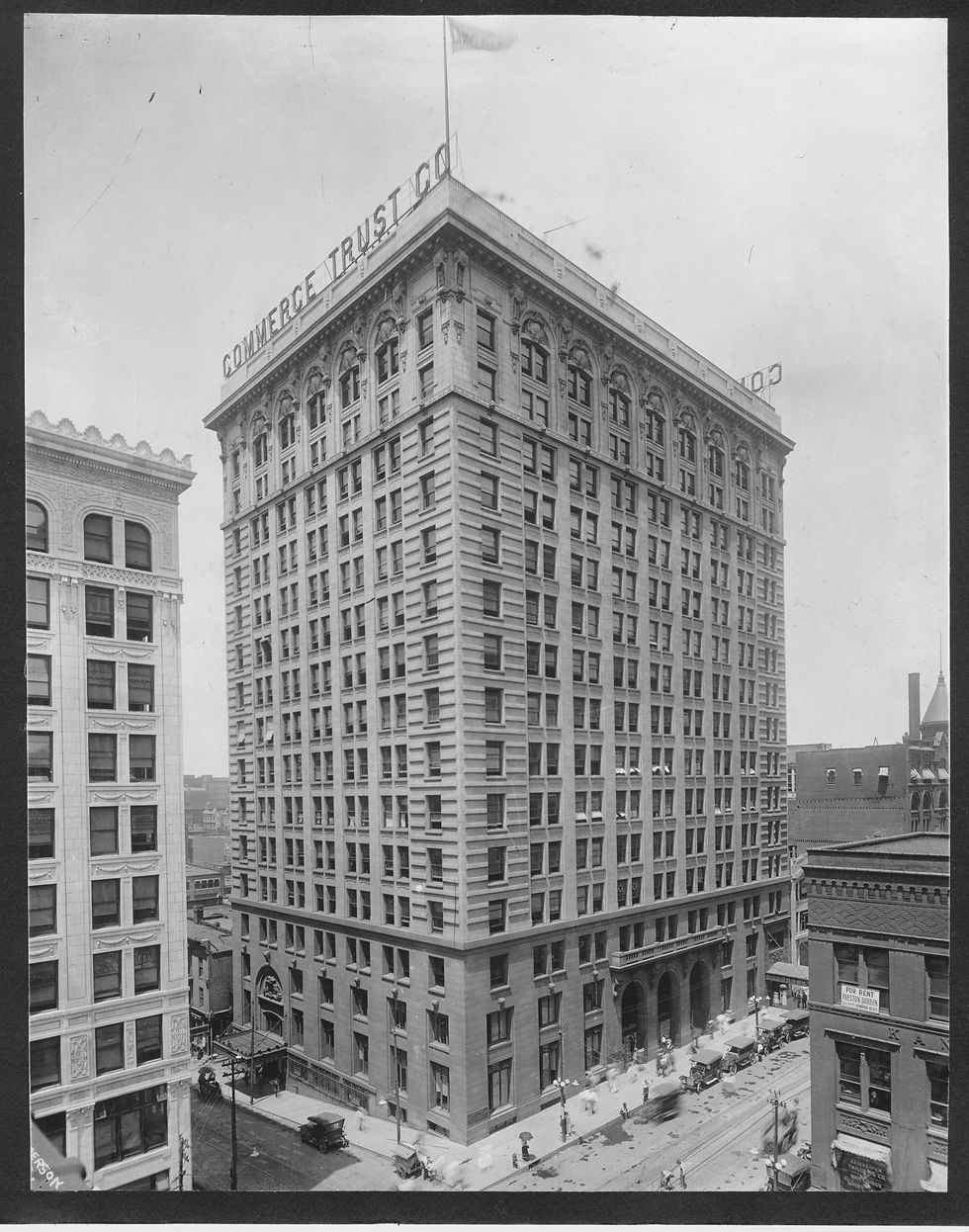
Commerce Trust at 10th and Walnut, circa 1928. Photograph by Anderson Photo Company. Henry D. Green Scrapbook. Photo courtesy of Kansas City Public Library, Missouri Valley Special Collections. Used with permission. View the archival record.
INSIDE THE BANK
BEFORE FAYE
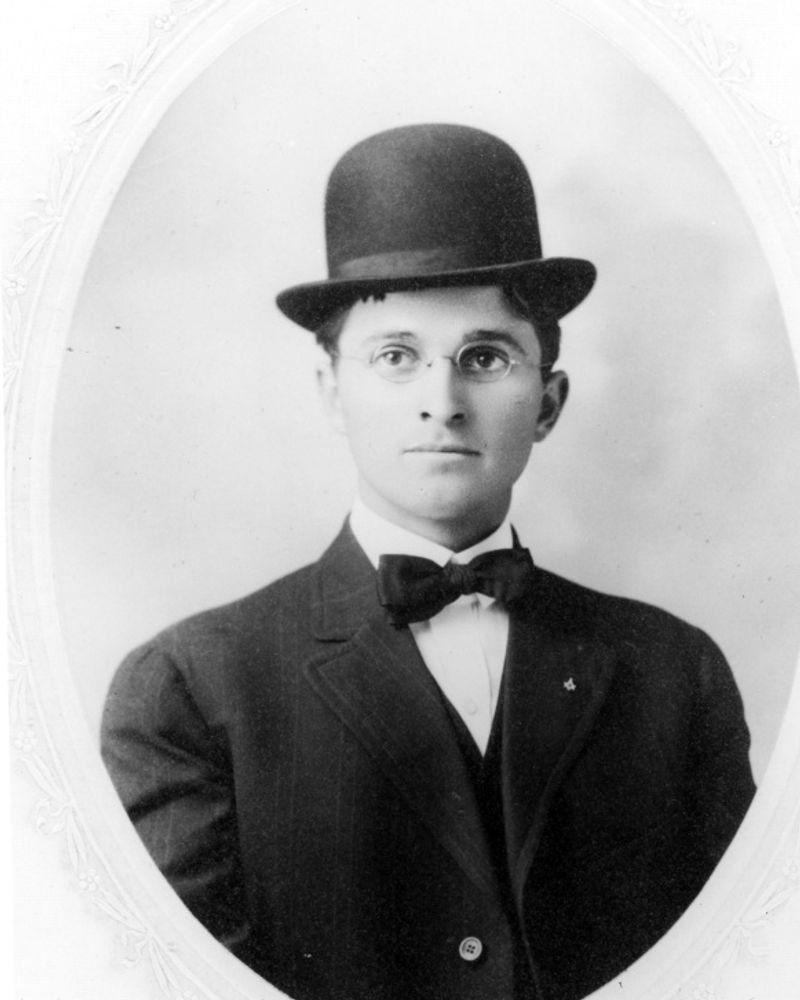
Harry S. Truman, circa 1908. Public domain. Harry S. Truman Library & Museum, accession 84-38.
Before the present building rose, the Journal Building occupied the corner. Harry S. Truman worked there for the National Bank of Commerce from 1903 to 1905.
He started at twenty dollars a month, worked around the vault and earned praise from a supervisor for watching closely enough to catch errors other clerks missed.
The Journal Building burned in 1906.
The new bank followed.
Then the banking system itself began to shake.
The Panic of 1907 hit while the skyscraper was taking shape. National Bank of Commerce went into receivership before the institution was recapitalized and returned to operation in 1908.
The institution survived its banking crisis as its new skyscraper took shape.
In October 1914, another piece of financial history unfolded inside. The first board of directors of the new Federal Reserve Bank of Kansas City met in the Commerce Trust boardroom.
They sat for a little more than three hours deciding how the new Reserve Bank would operate. The institution opened the following month.
By 1921, National Bank of Commerce and Commerce Trust had consolidated under the Commerce Trust name.
By the time Faye crossed Walnut in 1934, this was no new building.
The institution had endured a fire and a banking panic; the new building had hosted the Federal Reserve’s first directors.
It had a memory.
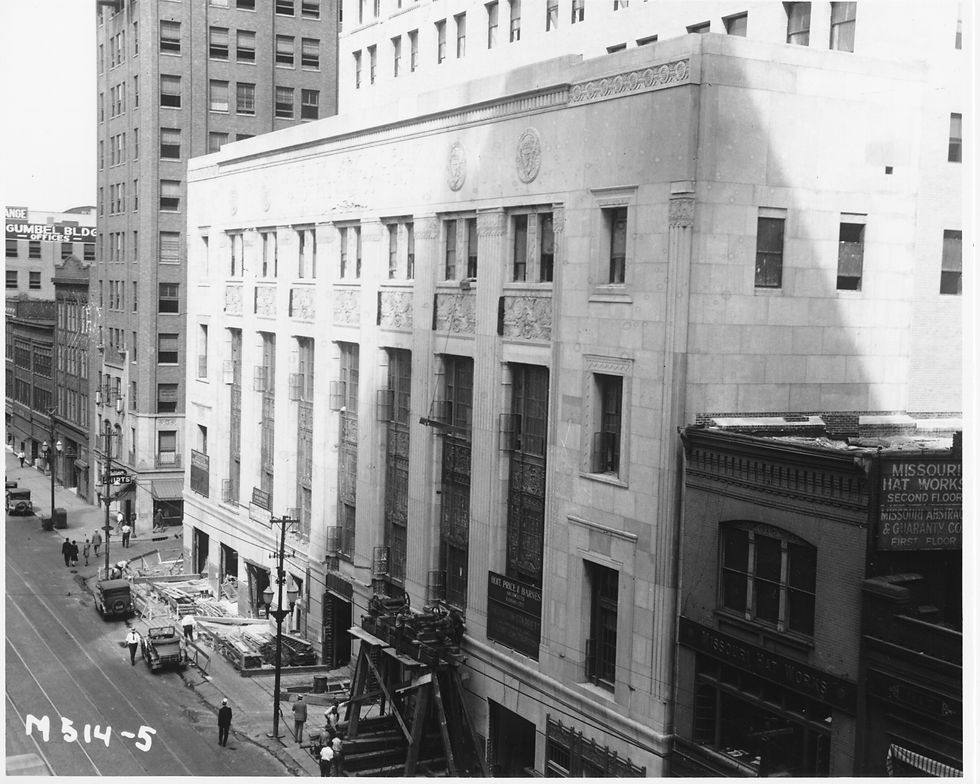
Looking toward Ninth and Walnut in 1930, while the Fidelity building was under construction—four years before the robbery. Photo courtesy of Kansas City Public Library, Missouri Valley Special Collections. Used with permission. View the archival record.
FOUR O’CLOCK
SIDE CONVERSATION This is the point where the archive begins to feel less like paper to me. Once I know the temperature, the clothes, the distance between the bank and the corner, Webster Kemner stops arriving as a name. I can see him step outside.
At four, in the office upstairs, Faye rolled the last sheet out of her typewriter. She covered the machine, put on her coat and worked the buttons through with bare fingers before drawing on her gloves.

Downstairs, she pushed through the door and turned north on Walnut.
Just after four o’clock, Commerce Trust employee Webster Kemner came out carrying a satchel of cash and securities bound for the post office.
The newspapers did not even agree on the simplest description of him. One called him a messenger. Another a clerk. Another an assistant teller.
They did agree on the human part: Kemner was married and the father of a small child.
He was not an anonymous figure carrying a prop through a crime story.
He was a bank employee walking a regular downtown route on one of the coldest days Kansas City had seen that year.
Kemner was armed.
He never got the chance to use the weapon.
Bank guard Doyle Swofford followed about twenty feet behind. Some contemporary dispatches described Swofford as out of uniform. From half a block away he could have looked like almost any other man in a dark coat and hat leaving an office.
The two men headed north.
They made it roughly one block.
Interpretive period sedan; the actual getaway car’s make is unconfirmed. Illustration: AVIA AREE.
At Ninth and Walnut, beneath the Fidelity tower, a small sedan entered the story.
The make is not reliably identified in the surviving reporting, so I am not giving it one.
Picture the proportions common to the street in 1934: an upright roofline, separate fenders, running boards, narrow tires.
Nothing exotic.
Nothing that would necessarily have pulled a pedestrian’s eye until the doors opened.
Three armed men came out.
One covered Swofford with a machine gun. Another leveled a pistol at the guard. A third confronted Kemner with a revolver.
The street was crowded.
It was after four on a Tuesday — clerks, stenographers, bank men, salesmen and shoppers beginning to spill back onto downtown sidewalks.
Then a shot.
Faye heard it before she understood what had happened.
One hard report against masonry and glass.
A woman stepped backward into her. A man’s felt hat hit the pavement and rolled toward the curb. Shoes struck stone. Someone shouted for police.
The hat, the woman and Faye belong to the reconstruction.
The panic does not.
Contemporary accounts describe cries from retreating pedestrians as Kemner fell.
He had been shot through the heart.
One account said Kemner had started to turn toward Swofford or move away. Another emphasized that he offered no resistance.
The satchel was taken.
The New York Times reported $1,000 in cash and $206,294 in securities. Other wire reports printed slightly different totals.
Surviving accounts identified $63,000 in government bonds consigned to Chicago and $1,000 in cash intended for the Dierks Lumber Company in Pineville, Arkansas.
The gunmen climbed back into the sedan.
The car went north on Walnut.
Kemner was carried into a nearby clothing store.
He was dead.
FROM THE CLIPPINGS The newspapers disagree at the edges — his exact title, some totals, details of the getaway. They agree on the center: a Commerce Trust employee was shot dead in broad daylight one block from the bank.
Faye stood with one gloved hand against her mouth.
Behind her, Commerce Trust still looked exactly as it had ten minutes earlier.
Granite. Steel. Carved stone. Gold ornament.
A building designed to communicate that certain things could not be touched.
And one block away, one of its employees was dead and more than two hundred thousand dollars in money and securities had disappeared into afternoon traffic.
THE CAR
I keep coming back to the car because that is how memory works.
It grabs an ordinary object and ruins its ordinariness.
Before four o’clock it was just another small sedan in a downtown full of them.
Afterward, everybody was trying to remember its shape, its plate, who sat where, which direction it went.
A little more than a week later, Kansas City detectives went to Tulsa and arrested twenty-seven-year-old Joe LaSalle. Police said an automobile found in a garage there answered the description of the robbery car.
The Tulsa car carried an Oklahoma license. Investigators said the Kansas City getaway car had carried a Kansas plate issued to a “John Draper,” a name police described as one of LaSalle’s aliases.
That did not prove the Tulsa automobile was the getaway car.
It shows how the case was being built: faces, plates, cars, eyewitness memory — whatever could be recovered before those details began changing in the retelling.
THE WITNESSES
WHO WAS WHO Webster Kemner — Commerce Trust employee, killed February 27, 1934. Doyle Swofford — bank guard walking behind him. Charles Taibi / Charles Ryan — identified by witnesses in contemporary coverage. Sam DeCaro — later convicted in connection with Kemner’s killing. James M. Kemper — Commerce Trust president. Peter Warren — arrested in the 1935 extortion case.
This is where I imagine Faye becoming useful to me.
Not because she can tell us who fired the gun.
She cannot.
The records do that work.
She lets me stand among the people who did not yet know they were about to become witnesses.
This was never a deserted-alley robbery.
People saw it.
Chief of Detectives Thomas J. Higgins told reporters that witnesses had made identifications. Contemporary coverage said two witnesses identified Charles Taibi — also reported under the alias Charles Ryan — as the man holding a machine gun.
Taibi was reported as twenty-four.
Sam DeCaro and Joe Martino were among those arrested in the first wave of the investigation. Newspapers identified Martino as twenty-six.
Later reporting described DeCaro as forty-one when he received a life sentence for participation in Kemner’s killing.
Those distinctions matter.
Arrest is not conviction.
Identification is not the same thing as proof.
The Pendergast-era newspaper record contains fact, allegation, rumor and political theater on the same page.
Faye, imagined. Pencil-style illustration created for AVIA AREE.

The arraignment of Charles Taibi and Sam DeCaro, March 1, 1934. This photograph records charges, not a verdict. Zeldin Collection of Journal-Post Glass Negatives. Photo courtesy of Kansas City Public Library, Missouri Valley Special Collections. Used with permission. View the archival record.
The archive identifies Taibi and DeCaro with KCPD Detective Ira Johnson, Assistant Jackson County Prosecutor M. W. O’Hern and Jackson County Prosecutor W. W. Graves.
Their clothing is almost unnervingly ordinary: dark suits, ties, closely combed hair, the felt hat that appears in photograph after photograph from the period.
Nothing in the image announces gangster.
That is partly why it works.
They look like men who could have stepped from almost any office doorway on Walnut.
Faye would not have seen that photograph yet.
She would have seen newspapers hit the street.
Bundles under a newsboy’s arm. Men stopping beneath signs to read the first lines. People pointing south toward Commerce and north toward Ninth.
The story changing slightly every time somebody repeated it.
Four men.
Five.
A woman at the wheel.
No, a man.
A machine gun.
Two pistols.
Somebody knew somebody.
That is what a city does immediately after violence.
It begins trying to turn confusion into a version that can be carried home.
KANSAS CITY AROUND HER
OBSERVATION The farther I researched, the more I had to fight the temptation to flatten 1934 into sepia. These people did not know they were living in an old photograph.
They were late for work.
Their feet hurt.
Their coats were heavy.
They complained about traffic.
They ate lunch.
They owed money.
They made plans for the evening.
The robbery happened in a modern American city that was still deciding what modern meant.

Downtown looking north near 14th and Walnut, circa 1930. The Power and Light and Fidelity towers are still under construction. Photograph by Curtiss-Wright Flying Service. Photo courtesy of Kansas City Public Library, Missouri Valley Special Collections. Used with permission. View the archival record.
Streetcars moved through downtown. Bank towers crowded Walnut. Art Deco buildings rose beside Classical façades. Automobiles had replaced most horse traffic but had not yet lost their running boards.
Office women worked typewriters upstairs. Messengers carried envelopes between banks. Men in three-piece suits crossed the same intersections as laborers looking for work.
Beyond the financial district was another Kansas City of the 1930s: jazz clubs, gambling rooms, ward politics and the wide reach of Tom Pendergast’s political organization.
That context matters, but the distinction matters more: no evidence found in this reporting establishes that the Kemner robbery was a Pendergast operation.
The political atmosphere belongs to the city around the crime, not automatically to the crime itself.
THE STORY DID NOT END WITH THE HEIST
In May 1935, Commerce Trust president James M. Kemper became the target of an extortion plot.
Kemper belonged to one of Kansas City’s most consequential banking families and stood at the head of the institution whose name still sits above the doorway.
The demand was $250,000.
Two suitcases.
Bring them to the Country Club streetcar line at 57th Street and Brookside Boulevard.
The threat said Kemper would otherwise be kidnapped and held for a $500,000 ransom and that members of his family would be harmed.
A young man who gave his name as Peter Warren was arrested when he met Kemper at the designated location.
Commerce kept operating.
Money crossed counters.
Checks moved through departments.
People opened accounts.
Later that same year, contemporary banking coverage reported that more than 21,000 people passed through the Commerce Trust lobby during the institution’s seventieth-anniversary celebration.
A year after a messenger had been killed carrying its money, thousands of people walked through the doors to celebrate the bank.
WINDOW NO. 9
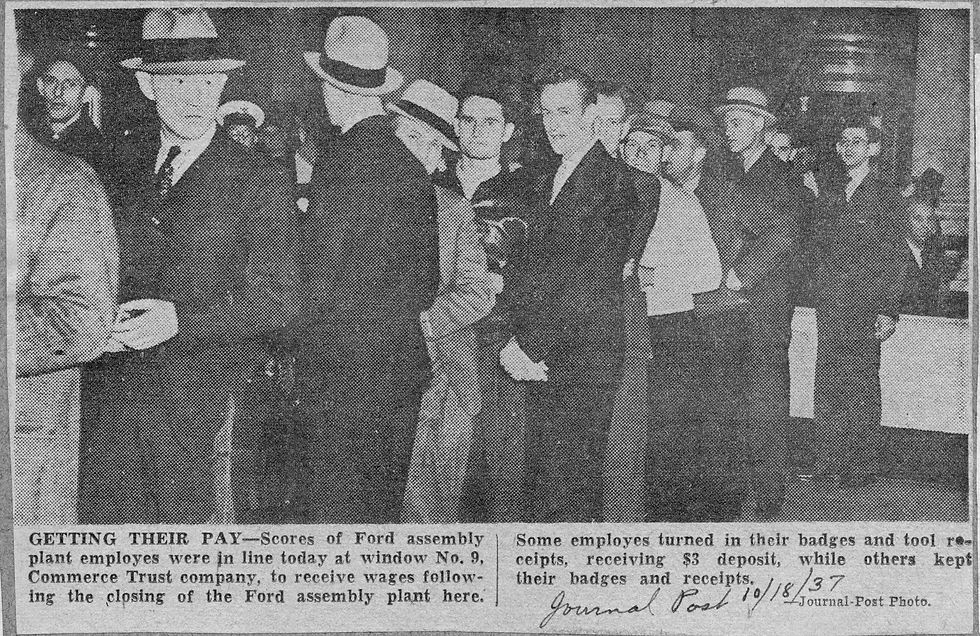
“Getting Their Pay,” October 18, 1937. Kansas City Journal-Post; William T. Kemper Sr. Scrapbooks, S7.17B, Page 216. Credit: Jackson County Historical Society. Used with permission. View the collection record.
FAYE’S NOTEBOOK Not the gun. Not the ransom. A line of working men waiting to be paid. That is the image I keep coming back to.
In October 1937, the Kansas City Journal-Post photographed scores of Ford assembly plant employees standing inside Commerce Trust at Window No. 9 to collect wages after their plant closed.
Brimmed hats filled the line. Jackets sat high on shoulders. Trousers were cut fuller than modern ones.
Some workers surrendered employee badges and tool receipts and received three-dollar deposits back.
The newspaper caption called it “Getting Their Pay.”
No ghost appears in the photograph.
Just men in coats.
Hats.
Shoulders.
A line.
Banks are usually photographed for architecture.
Window No. 9 shows the people.
Faye is older there in our telling.
She knows the building now.
She knows the weight of the front doors and the change in sound when shoes leave the sidewalk for the lobby floor.
She remembers the February cold.
She remembers the afternoon the crowd broke apart on Walnut.
She remembers Webster Kemner’s name because for a while everybody did.
She cannot know that one day almost everyone walking past the building will have forgotten him.
Buildings are good at that.
They keep the evidence after the witnesses disappear.
SOMETHING WAS STILL THERE
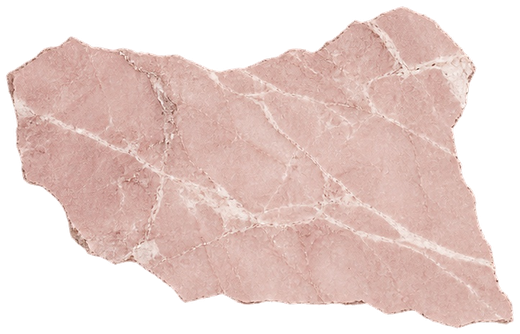
Stone detail from an original photograph by LaRee Durden / AVIA AREE.
OBSERVATION I did not know Webster Kemner’s name. I did not know about the Federal Reserve meeting upstairs, the extortion letters, Window No. 9 or the men standing in court. I only knew the building felt occupied by something older than its current use. Not haunted. Held.
Nearly a century later, the inscription remains cut into the façade.
The canopy still projects over the sidewalk. Heavy chains disappear into stone. Gold ornament catches the light. Above it sits carved stonework that most drivers will never study long enough to notice.
Granite, terra cotta, brick and steel were chosen to carry weight, take weather and last. The people moved through them much faster.
I did.
I was driving past when the architecture made me look again.
That is where this story begins.
Not with a ghost tour.
Not with an invented apparition in an upstairs window.
With architecture that looked as though it knew something.
It did.
Harry Truman worked on this corner before the present building rose. A banking panic followed. Kansas City’s Federal Reserve began organizing upstairs. A bank employee walked out one bitter February afternoon carrying a fortune and died one block away.
Witnesses remembered faces and a small sedan. Detectives followed license plates across state lines. The president of the bank was later ordered to bring two suitcases of money to a streetcar stop. Ford workers eventually stood at Window No. 9 waiting to be paid.
And the building stayed.
That may be what I was reacting to before I knew any of this.
A century of people had already passed through that doorway. Bank clerks. Messengers. Guards. Executives. Men looking for work. Men waiting for wages.
People who had no idea they would someday exist only as a name in a clipping or a face in a glass negative.
I came along decades later, slowed the car and looked twice.
The gold was still over the door.
The name was still in the stone.
For one second, before I knew the story, I felt it anyway.
RESEARCH NOTE Reporting for this feature draws on the Harry S. Truman Presidential Library, Federal Reserve Bank of Kansas City, National Register documentation, Missouri Valley Special Collections at the Kansas City Public Library, Jackson County Historical Society material, contemporary newspaper coverage and historical Kansas City weather records. Four archival photographs from Missouri Valley Special Collections are reproduced with permission from Kansas City Public Library and credited beside each image. The October 18, 1937 “Getting Their Pay” image (JCHS-KS-S7.17B-P216-0001) is reproduced in full with permission from the Jackson County Historical Society, granted October 5, 2026. The three requested 1935 Kemper scrapbook items and other archival material awaiting reproduction permission remain excluded. Additional historical images are public-domain items with source credits; the contemporary façade photographs are original AVIA AREE photography. Faye’s expanded day draws on the State Historical Society of Missouri’s Nell Donnelly Reed materials, a September 28, 1933 Nelly Don advertisement preserved by Texas Tech University, the February 26, 1934 Lawrence Journal-World, and historical records of Wolferman’s and Petticoat Lane. Her particular dress, meal, dialogue, bank patrons and movements remain fictional.
WITH THANKS TO THE LIBRARY
AVIA AREE thanks the Kansas City Public Library and its Missouri Valley Special Collections staff for their generous cooperation, research assistance and permission to share these archival photographs. Their work preserves the faces, streets and records that help us see Kansas City’s past with greater precision.
If this story sent you looking more closely at the city, we recommend exploring the Library’s exhibits and The Pendergast Years digital collection. Check the exhibition listings for current dates and locations, and make time to see the photographs, documents and local histories beyond this page.


STETSONA small felt hat, imagined for Faye.
KAYSERPlain leatherette gauntlets.$1.25 in February 1934.