The Liberty Memorial at the National WWI Museum and Memorial
- AVIA AREE

- May 25
- 4 min read
Updated: Jun 11

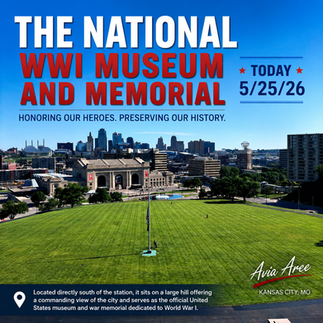


The stone catches the light before the city does.
Up on the hill, above Union Station and the rail lines, the Liberty Memorial stands with the kind of weight Kansas City understands: limestone, bronze, stairs, shadow, wind. From the lawn, it reads as a fixed point in the skyline. A tower. A marker. Something to steer by from the highway or from downtown streets when the late sun cuts through the glass.

The closer you get, the less it behaves like scenery.
It becomes a structure.
A place with doors, carved figures, stone walls, a tower shaft, an elevator, a final set of stairs, and a railing at the top where the city spreads out in every direction.
The Liberty Memorial is not only something Kansas City looks at.
It is something you can enter.
The Tower Above the Lawn
At the center of the memorial is the Liberty Memorial Tower, completed as part of the original monument in 1926 and dedicated by President Calvin Coolidge before a crowd of more than 150,000 people. The National WWI Museum and Memorial notes that the monument was built in the Egyptian Revival style and designed in the early 1920s by H. Van Buren Magonigle. (National WWI Museum and Memorial)
That style matters.
The tower does not disappear into the city. It refuses glass. It refuses trend. It looks built to outlast weather, argument, traffic, and fashion. Stone placed on a hill. A vertical line drawn into the Missouri sky.
The tower rises 217 feet above Memorial Courtyard and 268 feet above the North Lawn. Its cylindrical base is 36 feet across, narrowing to 28 feet at the top. From below, the shape pulls the eye upward before the body has decided to follow. (National WWI Museum and Memorial)
And then the body follows.
Visitors can purchase tower admission, take an elevator, and climb 45 stairs to the open-air observation deck. At the top, the memorial changes from architecture into geography: downtown, Union Station, the Crossroads, rail lines, rooftops, highways, sky. A full 360-degree view of Kansas City. (National WWI Museum and Memorial)
From below, the tower belongs to the skyline. From inside, it belongs to the body.
Memory and Future at the Entrance
Before the tower, there are the sphinxes.
On the south side of the memorial, two Assyrian Sphinxes guard the approach. One is named Memory, facing east toward the battlefields of France, covering its eyes from the horrors of war. The other is Future, facing west, shielding its eyes from what has not yet come. (National WWI Museum and Memorial)
That symbolism could flatten into a brochure line.
It does not when you stand there.
The figures make the idea physical. Before the elevator. Before the observation deck. Before the skyline opens up, visitors pass between what has happened and what has not happened yet.
Kansas City built that tension into the entrance.
A city can say what it values by what it makes people walk through.
The Four Figures Near the Top
Near the crown of the tower are the Guardian Spirits, sculpted by Robert Aitken. Each one stands 40 feet tall and represents a virtue: Honor, Courage, Patriotism, and Sacrifice. From the lawn, they appear almost fused to the tower, their forms part sculpture, part silhouette. (National WWI Museum and Memorial)
They do not perform grief.
They hold position.
That is the memorial’s strength. It does not need to shout to carry meaning. The scale does the work. The stone does the work. The height does the work. The city below answers in roofs, streets, trains, and windows.
The Flame That Is Made of Light
At night, the top of the Liberty Memorial gives off the Flame of Inspiration.
It is not an open fire. It is created with steam and lighting effects, visible from miles away. (National WWI Museum and Memorial)
That detail is worth keeping.
Kansas City’s memorial does not burn with flame.
It produces the image of one.
A symbol held in vapor and light above the city.
There is something almost too honest in that. Memory is often built this way — not as the thing itself, but as an effort to keep the shape of it visible.
The Wall That Moves from War Toward Peace
Along the North Wall, the Great Frieze stretches 148 feet by 18 feet. Sculpted in 1935 by World War I veteran Edmond Amateis, it represents the movement of mankind from war toward peace. (National WWI Museum and Memorial)
It turns the wall into a record.
Not only of conflict, but of what people hoped might come after conflict.
That hope can feel almost painful now. Peace is one of those words that becomes easier to carve than to keep.
Still, the wall remains. The figures remain. The tower remains. Kansas City keeps walking past them, photographing them, climbing them, explaining them to children, using them as a compass point when downtown bends out of view.
A Memorial Built to Be Approached
This is what makes the Liberty Memorial one of Kansas City’s most powerful structures.
It is visible from far away, but it was built to be approached.
It holds the museum below ground and the observation deck above it. It gives the visitor a sequence: lawn, stone, sphinxes, tower, elevator, stairs, sky.
The experience is not abstract.
It is physical.
You feel it in the incline. In the handrail. In the pause before stepping onto the observation deck. In the wind when it catches your jacket. In the way Union Station looks smaller from above, but not less important. In the way the tracks still cut through the city like old sentences.
From the top, Kansas City looks different.
Not smaller exactly.
Held together for a moment.
Stone beneath your feet.
Wind at the railing.
The city spread out in every direction.
Sources
Official site: National WWI Museum and MemorialArchitectural elements and symbolism: Elements of the Museum and MemorialTower admission and visitor details: Plan Your Visit — Liberty Memorial TowerCentennial and historical background: Marking 100 YearsTower ticket details: Tower AdmissionInstagram: National WWI Museum and Memorial Instagram


Comments