top of page

What Remains of the Kansas City Stockyards

Updated: Apr 24


Where industry shaped belief, and belief shaped a city

Before Kansas City became a cultural identity, it functioned as a system of movement where value was determined by speed, scale, and perception.

The Kansas City Stockyards, established in 1871 in the West Bottoms, became one of the most powerful livestock markets in the United States, second only to Chicago. But their significance was never only industrial. It was psychological. They shaped how people understood movement, value, and certainty itself.

Because in systems like this, people don’t just trade goods. They begin to trust the system doing the trading.


What the Kansas City Stockyards were

The Kansas City Stockyards were a 200+ acre livestock and meatpacking hub located in the West Bottoms district of Kansas City, operating from 1871 to 1991.

At their peak, they:

  • processed millions of livestock annually

  • connected regional agriculture to national rail networks

  • employed tens of thousands of workers

  • helped define Kansas City as a major industrial center

But beyond logistics, they functioned as a structure of perception—where value was constantly assigned through movement.


Arrival

The Stockyards did not begin as a system. They began as accumulation.

Railroads converged on Kansas City because geography made it inevitable. Two rivers, expanding rail networks, and flat industrial land created a natural point of convergence where movement concentrated faster than identity could form.

The earliest livestock arrivals were not yet industry. They were signals—repeated patterns of movement suggesting something larger was forming.

And here is the underlying shift that defines all systems like this:

When repetition becomes predictable, people stop seeing movement—and start seeing certainty.

That is where the Stockyards begin.


The Rise

By the late 1800s, the Stockyards expanded from small livestock pens into one of the most important livestock markets in the United States.

Rail lines connected multiple states. Auctions set regional pricing standards. Meatpacking companies built permanent operations around the West Bottoms.

At its peak, Kansas City handled livestock volumes second only to Chicago.

But scale alone was not the defining feature.

Synchronization was.

Everything moved together:


arrival, valuation, processing, distribution.

A system like this doesn’t just manage commerce. It teaches people how fast reality is supposed to move.


The Peak

At full capacity, the Stockyards operated like a living system of coordinated perception.

Prices shifted in real time. Labor moved continuously. Supply dictated behavior. Demand shaped expectation.

And at this stage of any system, something subtle happens:

People begin to trust the system more than they trust their own judgment.

That is how industrial systems become invisible. Not through force—but through repetition that feels natural.

Kansas City was no longer just processing livestock.

It was processing certainty.


The People

Behind the machinery were thousands of workers—immigrant communities, Black labor groups, and rural migrants who formed the backbone of daily operations.

Work was physically demanding and economically unstable, but it created entire ecosystems of life in the West Bottoms.

Neighborhoods formed around the system. Generations grew inside its rhythm.

The city did not grow beside the Stockyards.

It grew because of them.


The Shift

By the mid-20th century, the structure that supported the Stockyards began to dissolve.

Agricultural distribution shifted toward direct shipping models. Rail dependency declined. Meatpacking decentralized.

But the real change was not logistical.

It was perceptual.

Once a system stops feeling essential, it begins collapsing faster than its infrastructure suggests.


The 1951 Flood

The Great Flood of 1951 accelerated this transition.

Water overtook the West Bottoms, damaging rail lines, buildings, and industrial infrastructure. Recovery was partial, but the system never regained its former scale.

After the flood:

  • companies relocated

  • operations reduced

  • labor networks dispersed

The structure continued—but its center no longer held.


The Fall

In 1991, the final cattle auction took place.

There was no dramatic collapse. No single moment of ending.

Just the final cycle of movement—and then silence.

What remained was infrastructure without function, and memory without a system to carry it forward.


What remains

The Kansas City Stockyards are often remembered as industrial history.

But systems like this do not disappear. They convert into perception.
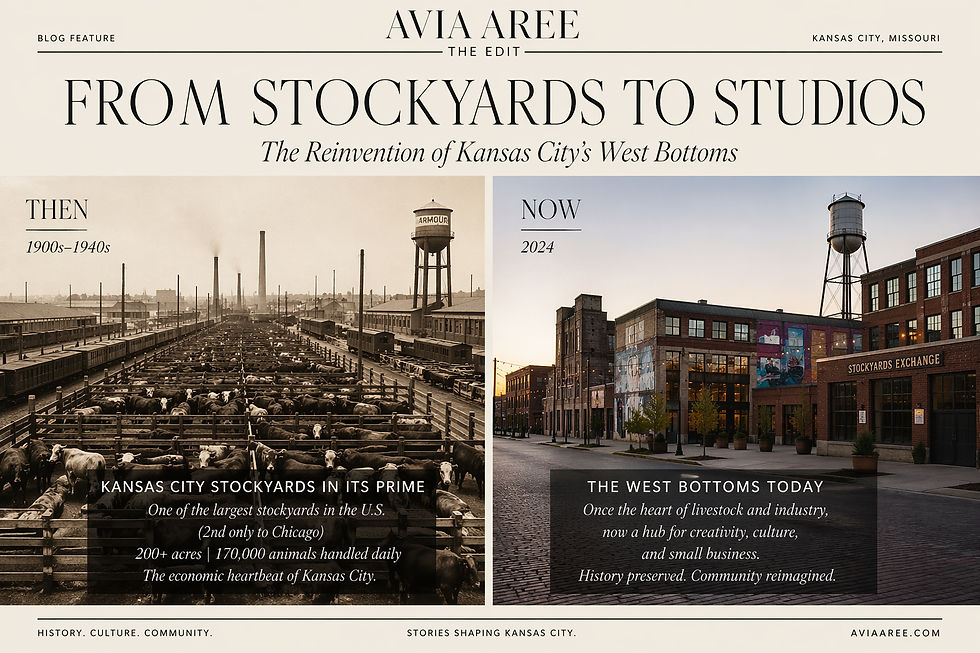
They become stories people repeat without realizing they are describing how belief once moved through physical space.

The Stockyards shaped more than an economy.

They shaped how scale is understood—how movement becomes meaning, and how repetition becomes trust.

And when the system ended, it didn’t erase itself.

It left behind something quieter:

The feeling that it was always temporary—even when it felt permanent.

Comments

Rated 0 out of 5 stars.
No ratings yet

Add a rating
bottom of page
AVIA AREE
Menu
AVIA AREE · TALK ABOUT THE WEATHER · LABOR DAY 2026

THE RAIN CAME HARD.
THE HEAT STAYED.

Overnight storms finally brought rain—and left outages, downed trees and damaged festival grounds behind. Labor Day climbs back into the mid-90s before Tuesday’s last hard push and a midweek break.

Read the complete edition
95°today’s high100°possible heat index60%Tuesday-night storm chance
TODAY IN KANSAS CITY

Start with what changed.

Storm cleanup

Check the block before the forecast.

Treat every downed line as live, give crews room and use Evergy’s map for restoration estimates.

Open outage map
Festival status

Irish Fest is closed today.

Sunday’s event ended early and did not reopen. SantaCaliGon’s vendor festival is also closed; its carnival runs 11–5.

Read today’s note
Getting around

Holiday service, normal Streetcar.

KCATA buses use Sunday schedules. KCK and Johnson County transit are off. KC Streetcar runs normal service.

Open service bulletin
1:10 p.m.

A Labor Day first pitch.

The Royals host the Diamondbacks at Kauffman Stadium. There is no Chiefs game today.

Open schedule
THE FULL LABOR DAY CRAWL · 13 STOPS

The whole city, in order.

01 · Weather

Heat holds on after the rain

Mostly sunny near 95°F today with a heat index around 100. Tuesday pushes near 99 before storm chances rise Tuesday night.

Open note
02 · Overnight

The storm left a real cleanup

More than 34,000 customers were reported without power Sunday night. Trees, lines and structures were damaged from Leavenworth to Raymore.

Open note
03 · Roads / Transit / Airport

Move like it is a holiday—and a cleanup day

RideKC buses run holiday schedules; KCK and Johnson County transit are off. The Streetcar runs normally. Check MoDOT and FlyKC.

Open note
04 · Sports

Royals at home for a Labor Day matinee

Arizona visits Kauffman Stadium at 1:10 p.m. CDT. There is no Chiefs game today.

Open note
05 · Lunch

Four indoor lunch moves

Burnt End BBQ, Fritz’s Railroad Restaurant, SPIN! Pizza and Unforked at Crown Center; confirm individual holiday hours.

Open note
06 · Free / Low-Cost

Four ways to keep the day light

Fare-free Streetcar, Crown Center browsing, Loose Park’s sprayground if safe, or an Independence Square walk.

Open note
07 · Neighborhoods

Check your own block first

Bonner Springs hail; Leavenworth trees; Raymore lines; Grandview outages. Leave room for repair crews.

Open note
08 · Arts & Culture

The festivals split three ways

Irish Fest is closed. SantaCaliGon booths are closed but carnival runs 11–5. Ren Fest remains scheduled 10–7.

Open note
09 · City Horoscope

Read the city by what it repairs

Every sign gets the same assignment: check a neighbor, read the closure twice and leave room for crews.

Open note
10 · Moon Note

A waning crescent keeps the night spare

Kansas City moves toward Thursday night’s new moon. Let the week narrow before it begins again.

Open note
11 · Editorial Discovery

Labor is visible when weather breaks things

A holiday for workers meets line crews, cleanup teams, vendors and neighbors restoring a city.

Open note
12 · Top Five

Five things that matter today

Avoid downed lines. Hydrate early. Recheck festivals. Royals at 1:10. Save Thursday’s 83-degree forecast for morale.

Open note
13 · Source List

The desk behind this edition

NWS, Evergy, RideKC, Streetcar, MoDOT, FlyKC, MLB, Crown Center, festival organizers, KCTV5, KSHB, DOL and Timeanddate.

Open note
Festival damage

The grounds became the weather report.

Irish Fest ended early Sunday and is closed today. SantaCaliGon’s vendor festival will not reopen Monday after booths were damaged, though the carnival runs 11 a.m.–5 p.m. Independence Square businesses remain open. The Kansas City Renaissance Festival remains scheduled 10 a.m.–7 p.m.

Read the complete edition
City in plain sight

Four blocks after the storm.

Bonner Springs

Hail in the overnight line

Quarter-size hail was reported. Photograph damage before cleanup and keep pets away from debris.

Independence Square

Festival booths closed; local doors open

SantaCaliGon’s festival portion is closed. The carnival runs 11–5 and Square businesses remain open.

Crown Center

An indoor reset

Shops are scheduled 10–5, with individual tenant hours varying. Confirm a restaurant before crossing town.

Grandview · Raymore · Leavenworth

Give the repair crews the lane

These were among the areas reporting heavy outages, downed lines or trees. Avoid blocked roads and never approach a wire.

From the AVIA AREE archive

Keep reading Kansas City.

From the archive

Liberty Memorial: the city’s long view

Keep reading Kansas City through the AVIA AREE archive.

Read story
From the archive

How Hallmark became a Kansas City story

Keep reading Kansas City through the AVIA AREE archive.

Read story
From the archive

A story in every sip

Keep reading Kansas City through the AVIA AREE archive.

Read story
From the archive

Berkley Riverfront at sunset

Keep reading Kansas City through the AVIA AREE archive.

Read story